
PSU History: First Off The Bus? A QB on a Mission
NOTE: This is the latest in a continuing series of offseason essays highlighting Penn State football's history of unique student-athletes. It is in response to Coach Matt Campbell and his staff reconnecting with the Penn State football alumni. These essays are designed to highlight history beyond the current generation and to remember players and stories that delve deeper into a proud legacy of excellence;
Here are links to the previous essays:
For several decades there was a subtle but incredible tradition at Penn State. When the teams boarded the blue buses to the stadium on game day Joe Paterno would sit in the front right seat on Bus 1. Across from him in the front left seat was the starting quarterback.
Every guy who ever started at Quarterback can tell you what it meant the first time they got that seat. If you want to see a grown man get emotional, ask a former starting Penn State quarterback about the bus ride sitting across from Joe.

But the real moment happened when the bus pulled up to the stadium. Joe would look over at the starting QB, give him a nod and then let the starting QB be the FIRST guy off the bus. It was a way for the head coach to say “You're the leader now--as you go, the team goes.” A reminder that the quarterback has to be an extension of the head coach.
The tradition of the QB being the first off the bus has been gone, but it doesn't lessen how important the QB is to the success of the team.
As with the other historical essays in this collection, the focus here is not on the current generation of QBs. Trace McSorley, Christian Hackenberg, Drew Allar and others are well-known to current fans. This fall Rocco Becht will take center stage.
This essay is about the guys who came before and the missions they led.
The mission and plan changed year to year or even game to game. Matchups, weather and other factors all came into play stretching back generations. Across time Penn State QBs thrived in a variety of differing demands and circumstances.
And nowhere was that concept more obvious than the 1982 Penn State team. Last week’s essay on running backs ended with the 1980 all-1st round draft pick backfield including QB Todd Blackledge and RB Curt Warner.
Before the 1982 season, Warner was seen as a Heisman Trophy frontrunner. But early in the 1982 season, Penn State’s rebuilt offensive line had the coaches shifting the emphasis away from the running game. Blackledge opened the season with 4 TD passes in each of the first 3 games, including a wild 39-31 shootout with future NFL QB Boomer Esiason from Maryland.
In game 4 Blackledge threw for 3 TDs, including the game winner with 00:04 left on the clock to beat #2 Nebraska 27-24 in what many still consider the best and most dramatic win ever in Beaver Stadium. (Those of you old enough will recognize the NFL Films voice of John Facenda on the video).
Midway through the season, with the pass game established and a maturing offensive line, Blackledge’s mission as Penn State QB changed. Penn State shifted the focus back to the running game.

It remains one of the most balanced offenses in college football history. With the passing yards making up just over 50% of the total yardage, Penn State became the first National Championship team to win it all by passing for more yards than rushing.
Blackledge had an incredible record in big games. It started in 1980 at #9 Missouri. Leading 22-21 Blackledge took an option play, broke a tackle and went in from about 50 yards out to ice the game. He was 10-3 as a starter against Top-15 teams (7-3 vs Top 10 and 4-2 vs Top 5) and was 2-0 against teams ranked #1.
In both 1981 and 1982 Penn State played the NCAA’s toughest schedule. Penn State became the first National Champion to play the Nation’s toughest schedule.
Blackledge won the Davey O’Brien Award given to the Nation’s Best QB, was a 1st-team Academic All-American and the Sugar Bowl MVP in the win over #1 Georgia. He was a 1st-round draft pick in the 1983 draft, beginning a 7-year NFL career.
As his playing career ended, Blackledge began an Emmy-nominated broadcasting career that saw him in the ABC studio show, and then an in-game analyst. He is now NBC’s lead prime-time college football analyst for Big Ten Saturday Night Football.

The lineage of Penn State quarterbacks goes back over 100 years. From 1910 through 1913 a 5-5 quarterback from Harrisburg Eugene “Shorty” Miller would be a 3rd-team All-American for Penn State on his way to a College Football Hall of Fame career, before playing pro football for Massillon.
The 1911 (8-0-1) and 1912 (8-0) teams would finish without a loss and be later recognized as National Champions by the National Championship Foundation. The 1912 team outscored their opponents 285-6 including shutouts over Villanova (71-0) at Ohio State (37-0) and at Pitt (38-0) to close the season.
Two other Penn State quarterbacks played in the NFL in the 1920s. Mike Palm played three years, and Harry Robb 5 seasons.
With the arrival of Rip Engle from Brown to be Penn State’s head coach, his offense benefited the quarterbacks at Penn State. And for the next 61 years the quarterback’s role each year depended on the team’s needs. It was about getting wins over personal stats and glory.

Some years they were gunslingers (or riverboat gamblers), some years they were game managers, but the goal was always to win as a team. To be sure, there were guys whose job was to be exciting playmakers as the way to victory.
In 1957 Milt Plum was taken in the 2nd round with the 17th overall pick by Cleveland. He would embark on a 13-year NFL career that included All-Pro and Pro Bowl Honors.
But his time at Penn State saw him not only as the starting QB but also as a safety, a kicker and punter. In an epic 1955 win over Syracuse and Jim Brown, Plum threw a TD pass, intercepted a Syracuse pass, made an open-field tackle on Jim Brown to save a touchdown and scored a TD to tie the game and then kicked the extra point to win it.
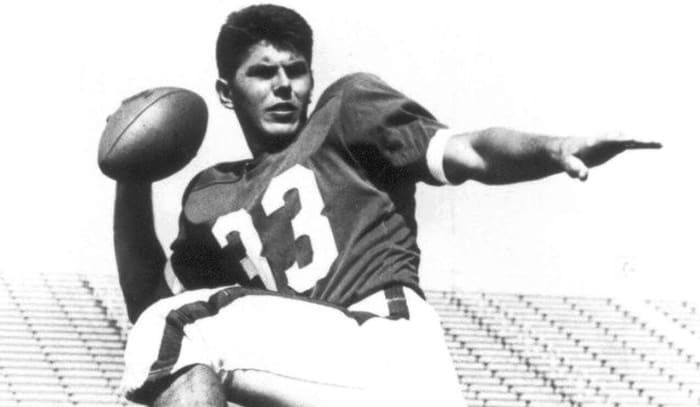
Right after Plum, Richie Lucas emerged as the starting quarterback. He earned the nickname “The Riverboat Gambler” because of his athleticism and daring style of play. Lucas became Penn State’s first-ever 1st-Team All-American QB, and the first of Penn State’s 7 Maxwell Award winners. He finished 2nd in the Heisman voting. He was a first round pick in the 1960 draft by Washington.
In the 1959 Liberty Bowl, Lucas was injured and was replaced by Galen Hall. Hall would complete a pass on a fake field goal to beat Alabama 7-0 in that game. After starting for Penn State in 1961, Hall played 2 years in the NFL before a long coaching career at places like Oklahoma, Florida, the NFL, and NFL Europe before returning to Penn State.
After Galen Hall, Pete Liske took over in 1962 and was drafted in 1963 as a quarterback and defensive back, which was not an uncommon occurrence back then. He played for 9 years in the NFL. The late 1960s saw Tom Sherman lead Penn State to a Top-10 finish in 1967 in Joe Paterno’s second year as head coach. Sherman played two years in the NFL before a long career as an assistant coach, much of it as the WRs coach at Virginia.
As the game evolved, different styles of quarterbacks emerged for different types of teams. There were QBs leading a productive running game on teams with a great defense. They were tasked with controlling the game, avoiding turnovers and making the plays needed to win the game..
No two quarterbacks personified that mission more so than Chuck Burkhart in 1968 and 1969 and John Shaffer in 1985 and 1986.
Burkhart became the starter in 1968 and for two years all he did was win. Burkhart led Penn State to two straight 11-0 seasons and Orange Bowl wins. He may not have been the star of the show, but when it counted most, he made the plays.
Trailing 14-7 against Kansas in the 1969 Orange Bowl, he hit a deep pass to get Penn State a 1st and goal. Three plays later he kept the ball for a TD instead of handing it off. Penn State went for two and was stopped, but Kansas had 12 men on the field. Penn State made the 2-point conversion, won the game and finished 11-0.
Like Burkhart John Shaffer was a proven winner. In 1985 he won the starting job. His first start was a 20-18 upset win on the road against #7 Maryland in a year where Maryland fans actually believed they had a shot. All PSU did was win, beating 7 of their first 8 opponents by one score or less
In a 19-17 win over #10 Alabama, Shaffer got hurt for a play. Leading 12-10 and facing a 3rd and short, backup Matt Knizner came in. Every fan and media member in the press box expected a run up the middle. As a 16-year old stat guy in the press box I heard the comments. Knizner faked the ball and tossed a TD to tight end Brian Siverling to put PSU up 19-10.
Penn State would finish the season ranked #1 following blowout wins over Notre Dame (36-6) and at Pitt (31-0) before the only loss as a starting QB in John Shaffer’s career (he finished 66-1 as a starter going all the way back through high school at Cincinnati Moeller). Second ranked Oklahoma beat Penn State for the National title.
After the 1985 season, Joe Paterno made it clear that Shaffer would still have to compete with Knizner for the starting job all over again. The 11-1 record and #2 final national ranking carried no weight in the offseason. A Harrisburg Patriot-News (now PennLive) fan poll saw roughly 80% of the fans supporting Knizner.
Shaffer won the starting job and started the season 6-0 before the team traveled to Tuscaloosa to face #2 Alabama. Shaffer was efficient, made the key throws and even made a lead block on a reverse to Blair Thomas for a TD. Penn State rolled to a 23-3 win.
That team would go on to finish 12-0 and beat #1 Miami in the Fiesta Bowl for a National Championship concluding a two-year 23-1 run with Shaffer at the helm. Shaffer was also a 1st-team Academic All-American and went on to a highly successful career at Merrill Lynch and Goldman Sachs.
Other guys who had that same “Just Win Baby” mission were Tom Shuman who started in 1973 and 1974. Shuman quarterbacked the 1973 team that finished 12-0 and the 1974 team that finished 10-2. Shuman was 6-0 against top 20 teams, including wins over LSU in the Orange Bowl and Baylor in the Cotton Bowl.
At other times the Penn State quarterback’s mission was a starring role as a dynamic playmaker. In 1972 Quarterback John Hufnagel was a 1st-team All-American after becoming the first Penn State quarterback to pass for over 2,000 yards in a season. In 1971 and 1972 he led an explosive offense that featured him as a passing and running threat.
In 1971 he led Penn State to an 11-1 record and top-5 ranking which included a 30-6 win over Texas in the Cotton Bowl. He was drafted and played 3 years in the NFL before a long successful career as a QB in the CFL. He won the Grey Cup as a player and as a coach and the Super Bowl as an NFL assistant.
Penn State’s next star at QB emerged in 1976. Penn State started 1-3, before sophomore QB Chuck Fusina emerged as the team’s starter. With Fusina at the helm Penn State finished in the Top-5 in both 1977 and 1978. The 1977 team rolled to an 11-1 with wins over #9 Houston, #10 Pitt and #15 Arizona State in the Fiesta Bowl (which started Penn State’s love affair with that bowl game).
In 1978 Fusina led Penn State to an 11-0 mark and the #1 ranking for the first time in school history. He won the Maxwell Award, was a 1st-team All-American and finished 2nd in the Heisman voting. In 1978 he was at his best in big games.

In September, Penn State beat #2 Ohio State on the road 19-0. On a gorgeous November day he threw for 234 yards and a TD in a 27-3 rout over 5th ranked and undefeated Maryland that landed him on the cover of Sports Illustrated.
Fusina finished as the school’s all-time leading passer before being drafted by Tampa Bay in the 1979 draft. When the USFL started up, Fusina signed with the Philadelphia Stars in a league flooded with a lot of NFL talent (QBs Jim Kelly and Steve Young among them). Fusina led the Stars to all three USFL championship games, winning the last two. After the last USFL season, Fusina went back to the NFL and finished with 5 years in the NFL and 3 in the USFL.
Hufnagel and Fusina started a shift towards more wide-open offenses, paving the way for Todd Blackledge and guys who would follow him. In 1983 QB Doug Strang threw the ball a lot in a season that saw top-5 wins over Alabama and West Virginia and concluded with wins over Notre Dame and Washington in the Aloha Bowl.
In 1988 injuries would push freshman Tony Sacca to be the first true freshman to start at quarterback for Joe Paterno. Tony and another talented QB, Tom Bill, would battle the next few years with Sacca emerging as the guy. In 1990 and 1991 Sacca was the team’s leading passer and set a school record for single-season passing yardage.
In 1990 the team started with one score losses against Texas and at USC, before rattling off 9 straight wins including at Alabama and a comeback win at #1 Notre Dame. In that Notre Dame game Sacca threw for 277 yards and 3 TDs.
A year later the 1991 team finished #3 in the country with big wins over #8 Georgia Tech (34-22), #12 Notre Dame (35-13) and #10 Tennessee (42-17) in the Fiesta Bowl. Sacca would get drafted in the 2nd round by the Cardinals and play a couple of years in the NFL.
After Tony Sacca, his brother John was in a quarterback competition with Kerry Collins. In 1992 injuries forced another future starting QB freshman Wally Richardson into a start before he redshirted in 1993. Collins emerged as the go-to guy in the 1993 season. But a less than exceptional pass game early that year led to one hilarious exchange.
After a 21-20 win over USC, Penn State headed to Iowa for their first-ever Big Ten road game. Penn State won the game 31-0 on the strength of great defense and a run game, while the pass game struggled.
Former Eagles Coach Dick Vermeil was the ABC TV analyst for the game and during what he thought was a timeout, he uttered to Brent Musburger “Brent, Penn State’s pass game sucks.”
Unbeknownst to Vermeil, it went out over the air live. When he got home his wife told him that he owed Joe Paterno an apology, so he wrote him a note. Back then, Joe had a habit of making a copy of letters sent to him. He’d write a note on the copy of the letter and send it back, so that you’d know he’d seen it personally.
A few days after Vermeil sent his apology, he saw a letter from Joe in his mailbox. Joe’s response was a note written on a copy of the letter Vermeil had sent, “Thanks for the note and the apology……but you’re right.”
But he wasn’t right for long. From the first week of November through the end of Kerry Collins' senior season, Penn State went 17-0 with a 7-0 mark against ranked teams. The end of the 1993 season concluded with a 31-13 Citrus Bowl rout of #6 Tennessee that set the stage for the 1994 season.
The 1994 season was a masterpiece, a 12-0 National Championship team that featured perhaps the greatest offense in college football history. And Collins was nearly flawless.
Collins would surpass 200 yards in 10 of 12 games in 1994 (others he sat out good chunks of the 2nd half because of lopsided scores). In the 31-24 win at #5 Michigan, he threw the game-winning strike to Bobby Engram. On the road against the nation’s best defense, he was 7 for 7 passing on a 96-yard drive into the wind to clinch the Big Ten title with a 35-31 win over Illinois.
He led the nation’s top offense racking up 520 yards per game even though the starters sat out 12 full quarters of routs that included wins over USC (38-14), Iowa (61-21), Ohio State (63-14) and Michigan State (59-31). He finished his career with a 38-20 win over Oregon in the Rose Bowl. Collins set the PSU single-season passing record and led the nation in pass efficiency. He won the Maxwell Award, was named 1st-team All-American and was a Heisman Finalist along with teammate Ki-Jana Carter.
In the 1995 NFL draft he was selected in the 1st-round (5th overall) by Carolina. For the next 17 years he had a Pro Bowl caliber NFL career and started Super Bowl XXXV for the New York Giants. In 2011 he finished his career with over 40,000 passing yards, which ranked among the Top 10 all-time in NFL history (he still ranks among the top 25).
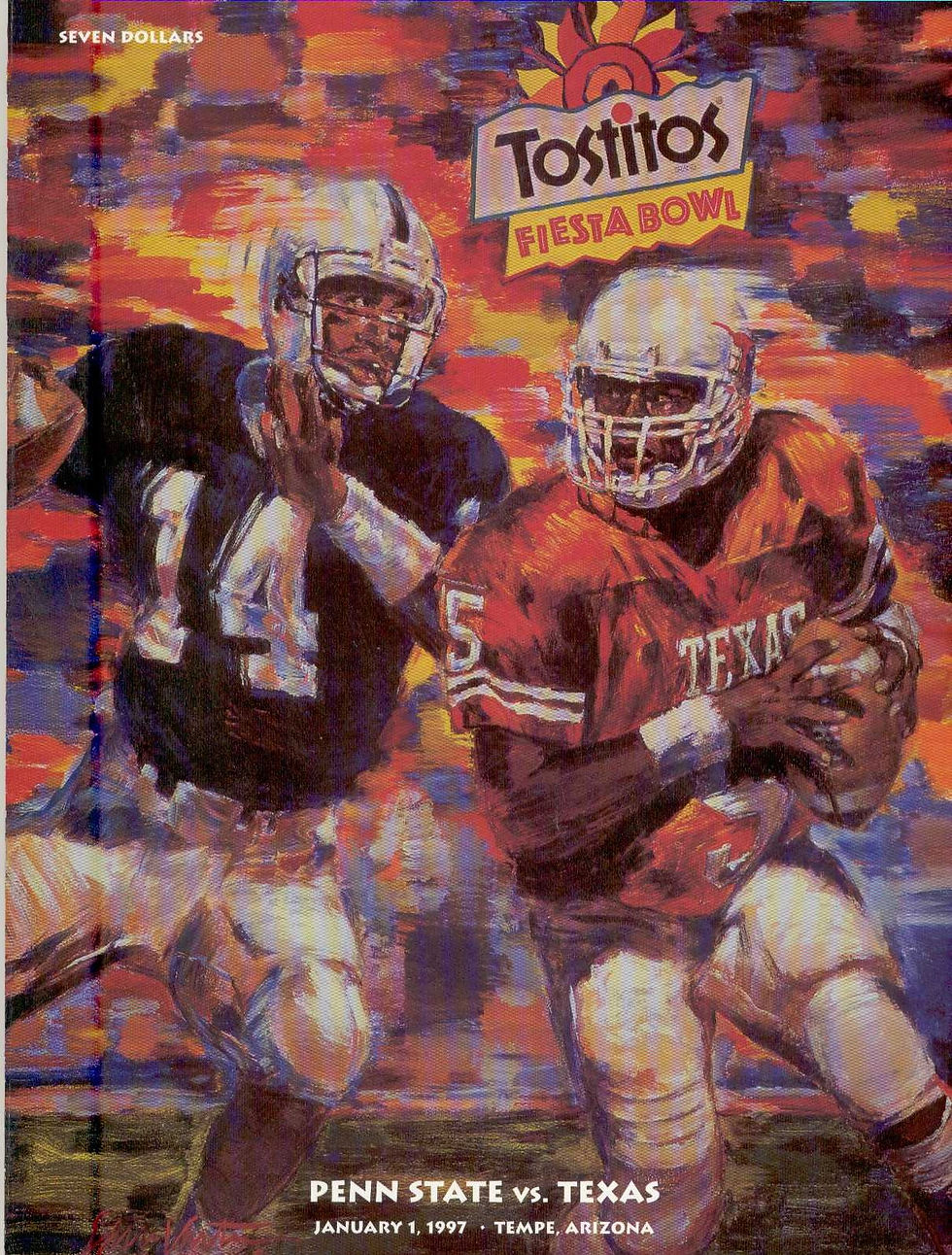
Kerry Collins left big shoes to fill but in 1995 and 1996 Wally Richardson prove capable of leading Penn State. The next two years Penn State would rack up 7 wins against ranked teams (Texas, Auburn, USC, Iowa, Northwestern & 2 over Michigan). Two of those wins were bowl-game laughers in the Outback over Auburn (43-14) and in the Fiesta over Big XII Champion Texas (38-15). Wally would get drafted by Baltimore and spend three years in the NFL.
In 1998 & 1999 QB Kevin Thompson would lead the team in passing. He was a tall QB with a big arm. Kevin Thompson made what is still of the most memorable passes in PSU history, the game-winning TD pass to Chafie Fields to win at Miami. He graduated and began a 6-year career in the NFL.
That same year Joe Paterno started to use QB Rashard Casey as a change of pace QB. Casey was a gifted athlete, a guy that was years ahead of his time. But his story at Penn State looms much larger than the playing field.
In May of 2000 Rashard Casey returned home to Hoboken, NJ over Mother’s Day Weekend. While at home he was falsely accused and charged with assaulting an off duty, out of uniform white police officer.
The national sports media had simply labeled it as an unprovoked racist attack on a white police officer by Penn State’s Black starting quarterback Rashard Casey. None of it was true. In the end, not only was he cleared by a grand jury, he sued the city and won damages for a wrongful prosecution.
But the months between May and when he was cleared in late fall seemed like an eternity. The media demanded that he be kicked off the team, and the howls of protest were difficult to ignore. Vile racist tirades and even threats were mailed and e-mailed to Rashard, Joe Paterno and to me as his quarterback coach. But what we as grown men had to deal with paled in comparison with what Rashard was facing.
Backed by a supportive athletic director and university President, we stood our ground, defended his right to due process and were ultimately proven right. Our faith in him was based on his honesty and character.
But ultimately his skill set was ahead of its time for the NFL and during draft interviews several teams expressed skepticism about his innocence. That probably cost him a chance to play in the NFL.
For almost his entire senior season the specter of the legal process playing out loomed over him and had an impact on how he played. After Joe Paterno died, a note was found in his files that stated “If it costs us some wins to stand up to a corrupt sheriff, I am willing to do that.”
Every now and then, for those that watched him play, it’s hard not to think of what might have been for Rashard without those long six months.
Even in the year 2000, a quarterback’s race was still an issue for some. Imagine how it must have been thirty years earlier.

In 1970 Mike Cooper became Penn State’s first Black starting quarterback. The move was not welcomed by all. Some of the criticism was racist in nature with people claiming that Joe was giving in to pressure from the NAACP, which of course wasn’t true. The team struggled to a 1-3 start before John Hufnagel emerged as the new starter.

Joe Paterno would often second guess if he could have done a better job helping Mike Cooper at that time. Joe was a guy who as a Brooklyn Dodger fan had witnessed Jackie Robinson’s first years in the major leagues.
Eventually Cooper was replaced by John Hufnagel, but Cooper remains the man who broke that barrier at Penn State. In 12 of Joe Paterno’s final 20 years a Black quarterback started some or all of the games for Penn State.
As fate would have it, at Rashard Casey’s last home game, Penn State defeated Michigan State 42-23. In that game Casey threw for 3 touchdowns. In the crowd that cold day, making his official visit was a quarterback from Richmond, VA named Michael Robinson.
His interest in a big-time College of Communications and his appreciation for how Joe Paterno had stood by Rashard Casey told him something was different here. He ultimately signed with Penn State.
While Zack Mills, who finished as Penn State’s all-time leading passer, was the team’s starter from 2001 through 2004. Mills mobility was a perfect fit for the type of offense Penn State was trending towards, mobile QBs as true run threats. That became crystal clear in the 2001 Ohio State game.
Joe Paterno was set to break Paul Bryant’s NCAA FBS all-time record of 323 wins, but Penn State fell behind 27-9 in the 3rd quarter. Mills would then make one of the iconic plays in Penn State history. Facing a 2nd and long he took the option to his right, cut up field, hurdled a defender, bounced off safety Mike Doss and raced 69 yards for a touchdown. It sparked a twenty-point rally and a 29-27 win over the Buckeyes. Mills set the total offense record of 418 yards with 280 yards passing and 138 yards rushing.
After redshirting in 2001 Robinson played QB, RB and WR from 2002-2004 so he could get on the field. In the 2002 offseason, we designed a bunch of plays with Michael and Zack Mills in the game at the same time. It was the wildcat before anyone called it that. To keep it secret over the course of preseason Michael, Zack and I would go into Holuba Hall alone to walk through what we were planning. It wasn’t until game week against #7 Nebraska that we unveiled them in practice to the rest of the team. Michael didn’t even tell his mom what was going on. The surprise worked and Michael scored a couple of TDs against the Huskers in a 40-7 rout.
The next two years were not always easy. Injuries hampered Mills’ career and there was real frustration there. But Mills' last game was a season-ending rout of Michigan State that set a confident tone for 2005 and helped sign highly touted recruits Justin King and Derrick Williams.
Michael remained at Penn State. In 2005 Joe Paterno stated that it was Michael's team. After a 3-0 start the team headed to Northwestern. With just 2:00 to go and trailing 29-27 Robinson took the field and after three plays faced a do or die 4th and 15. He hit the pass, then threw the game winner and a confidence was born.
The team took off and Michael proved time and time again what a clutch player he was. At Michigan he made an epic two-minute drill. He converted a 3rd and long & a 4th and long before breaking tackles on a quarterback draw to take the lead. If the score had held up, it would’ve been recognized as one of the greatest drives in Penn State history. During that 11-1 season Michael never left the field for the last time without a lead. But rather than let the loss linger, the team rallied to win out.
For the season Michael was named the Big Ten MVP, earned All-Big Ten honors, was named the National Player of the Year by Sports Ilustrated On Campus Magazine and finished 5th in the Heisman voting. He set Penn State’s season record for total offense with 3,156 yards (2,350 passing + 806 rushing). At Illinois he tied the school record for TDs with 6 (4 passing and 2 rushing) in just the first half of a 63-10 rout.
Penn State had a final #3 ranking, that included Big Ten and Orange Bowl titles. In the 2nd quarter of the Orange Bowl, facing a Florida State defense with 5 future NFL 1st round picks, he had a shoulder separation in his throwing arm. Rather than go in for x-rays he told the doctors to pop it back in and then played through 3 OTs to get the win. His 2005 season remains one of the most remarkable of any in school history and he set Penn State up to succeed for years to come.
He hosted another QB, Daryll Clark, on his visit and sold him on Penn State. After 2006 & 2007 when Anthony Morelli passed for over 5,000 yards and had bowl wins over Tennessee and Texas A&M, Clark took over in 2008.
Clark posted record numbers in 2008 & 2009 on his way to becoming Penn State’s first two-time 1st team All-Big Ten QB and the 2009 Big Ten MVP.
In 2008 Clark led Penn State’s Spread HD offense to a Big Ten Championship and a Top 10 finish. Penn State coaches withheld parts of the offense in season opening routs of Coastal Carolina, Oregon State, Syracuse and Temple before the White Out game against 22nd ranked Illinois. The whole country witnessed what came next.

The Spread HD offense ranked among the Top 10 in Big Ten History in several statistical categories and the starting unit converted 3rd and long (11+ yards) at an unheard-of rate of over 50% for the year. Clark would conclude his career the next year with an 11-2 season, a Top 10 finish and a 19-17 Capital One Bowl win over LSU in the worst field conditions in the modern era.
The bridge between the older era and the modern era is Matt McGloin. Matt came to Penn State and would eventually become the starter before a multi-year NFL career. Matt would make his biggest memories at Penn State with comeback wins in Joe Paterno’s 400th and 409th wins and the season finale in the 2012 win over Wisconsin.
The 400th win comeback began with PSU trailing 21-0 late in the first half. Matt McGloin engineered a 90+ yard drive in under 50 seconds sparked a 35-point run and a 35-21 win over Northwestern. The 409th win in Joe Paterno’s last game was a lousy, snowy day that made passing the ball nearly impossible. Down 7-3 late in the game McGloin moved the team down the field for a 10-7 win that set the all-time wins record for an NCAA Division 1 coach.
Those memories have faded with time, but they still represent a legacy and a history that set the stage for the guys who followed. From being the first guy off the bus with a mission each game and each year, Penn State's QB history of quarterbacks on and off the field has left an incredible legacy.


Nice overview of Allpanelexch and its available options. The information is presented in an easy-to-read manner and can help users understand the platform better. This post provides a useful starting point for people interested in exploring online exchange services and learning more about different features.
https://www.allpanelexch.com.co/
Jay ... your father used to say that he held the record at Brown for the most interceptions. Was this when he played quarterback or else when he was a defensive back?