
PSU History: PSU's Incredible Running Back Tradition Carries the Ball
Updated: Apr 17
NOTE: This is the latest in a continuing series of offseason essays highlighting Penn State football's history of unique student-athletes. It is in response to Coach Matt Campbell and his staff reconnecting with the Penn State football alumni. These essays are designed to highlight history beyond the current generation and include great players and stories that delve deeper into a proud legacy of excellence;
Here are links to the previous essays:
Right or wrong, Penn State’s reputation on offense for many years had been one based almost exclusively on a power running attack. In the 1970s a local youth named Chris Fowler was going to Penn State home games.
That local youth Chris Fowler is now the prime-time voice of college football on ABC/ESPN. But he once said to me that his earliest college football memories were forged by the PA announcer in Beaver Stadium saying, “Bob Torrey on the carry…..it’s 2nd and 6 for the Lions.”
It was a simpler era. You could go in and out of the stadium at will and even slip your ticket stub through the fence to get your friend in the game. It was the era of 3 yards and a cloud of grass clippings (with the nation’s best turfgrass management school the home field never had clouds of dust).
From the mid-1970s through the 1980 draft Penn State running backs were athletic but bruising runners. Tom Donchez (1975), Steve Geise (1978), fullback Bob Torrey (1979), fullback Matt Suhey (1980) and tailback Mike Guman (1980) were all drafted by the NFL. Suhey (10 years and a Super Bowl win) and Guman (9 years) went on to long NFL careers.
Like Chris Fowler, many of us of a certain “vintage” share those Beaver Stadium memories.
Suhey ran for over 2,800 yards, finished as Penn State’s 2nd all-time leading rusher and still ranks in the top 15. And he did a lot of his best work while also wearing an old-school neck roll. Mike Guman scored on 4th and 2 on a cold November day to clinch an 11-0 season against Pitt.
As that era helped elevate Penn State’s program on a national level, the country noticed that run-first mentality. But it wasn’t new. The secret was getting a group of talented players and competitive players at the same position who would selflessly push each other to reach their potential.
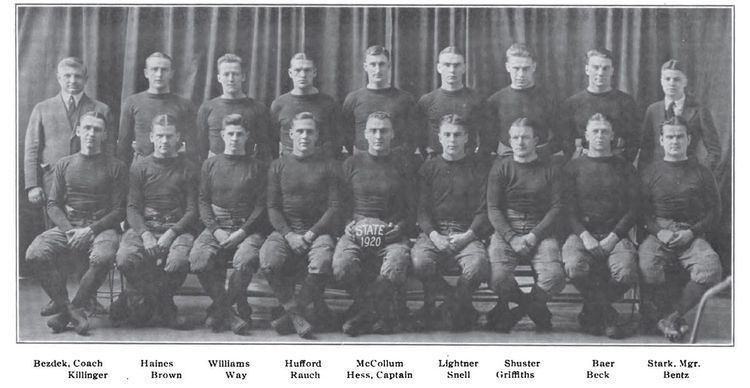
The first evidence of stockpiling elite running backs came in the stretch from 1920-23 when Penn State had three 1st-Team All-Americans and a 2nd-team All-American in 4 years. In 1920 Charlie Way led the team to a 7-0-2 record. His running mate in that backfield was 2nd-team All-American RB Henry “Hinkey” Hains. Both Hains and Way played pro football. Way was a 1924 All-Pro for Frankford and Hains played 7 years for the Giants and the Staten Island Stapletons.
All-American and future College Hall of Famer Glen Killinger led his team to an 8-0-2 record in 1921. That team had ties at Harvard and at Pitt, both powers at that time, before a season-ending win at Washington. The 1921 team was part of a 30-game stretch without a loss tallying a record of 25-0-5. That is the 2nd longest unbeaten streak in school history eclipsed only by a 31-game unbeaten streak that stretched from 1967 to 1970; a record of 30-0-1.

Another 1st-team All-American RB and future college Hall of Famer emerged in the 1923 backfield when Harry “Light Horse” Wilson starred for the PSC eleven (it was known at Penn State College back then). The early twenties were a time of growth for college football. Penn State's first games hitting the 50,000-attendance were road games at Penn (1922), against West Virginia in Yankee Stadium (1923) and at Penn in 1923 when 56,000 were on hand for the State win.
That growth continued into the 1940s when another flurry of Penn State backs were drafted. The 1941 draft saw John Patrick drafted by Philadelphia and Chuck Peters taken by the NY Giants. The next year Len Knouse went to the NY Giants and Bill Smaltz went to Philly. And in 1944 Aldo Cenci was selected by Brooklyn.
By the late 1940s, as the game continued to evolve to the NFL fullback era, Penn State was a go-to school for the position that required one to be a tough runner, a great blocker and an effective receiver.
In 1948 fullback Jeff Durkota made it to the NFL Two years later Fran Rogel was drafted as a fullback by Pittsburgh. The 2nd-team All-American would go on to an 8-year NFL career including Pro-Bowl honors.
In the 1980s and 1990s the fullback pipeline was really humming. As Matt Suhey and Bob Torrey finished up the 1970s, they would be followed by more fullbacks. In the 1982 draft Mike Meade went in the 5th round to Green Bay.
In the 1987 draft’s 3rd round fullback Tim Manoa went to Cleveland with the 80th overall pick. The very next pick Manoa’s teammate and fellow FB Steve Smith was taken by the Raiders.
Steve Smith went on to a 9-year NFL career. He was tough, a great runner and receiver and commanded the respect of teammates and opponents alike. He was the lead blocker for Bo Jackson who recently shared a funny story involving Smith. It's easy to see the respect.
After his playing career he developed ALS and fought valiantly for over a decade, outliving every projection. It was part of the same fighting spirit that made him such a fierce competitor.
The next run of fullbacks occurred in the early 1990s drafts. In 1991 Leroy Thompson was drafted and played as a hybrid tailback/fullback in the NFL for 6 years. The man teammates occasionally called “Ulys” came to Penn State from Knoxville, TN snubbing the hometown Tennessee Vols.
During Joe Paterno’s home visit, the local media was camped outside the house while Joe, assistant coach Jim Caldwell and the Thompson family played Spades and talked. Ultimately Thompson came to Penn State where he partnered in the backfield with guys like Blair Thomas, Gary Brown, Sam Gash and Richie Anderson.
Gash and Anderson would both be drafted to long NFL careers. Sam came to PSU from Hendersonville, NC as Penn State continued expanding its recruiting footprint into the Southern states on the east coast.
While Gash played fullback at Penn State, tailback Richie Anderson was a tall 225-pound tailback with great receiving skills. He led the team in rushing in 1991 and 1992. In the NFL Anderson transitioned to fullback.
Both Gash (11 years) and Anderson (12 years) had long careers and became Pro Bowl fullbacks. No less than Bill Parcells expressed great admiration for both Gash and Anderson. A year after Anderson went to the league fullback Brian O’Neal made the NFL as an undrafted free agent.
Just a few years later, fullback teammates were drafted again. In 1996 Brian Milne went in the 4th round to Indianapolis and a 5-year NFL career, while Jon Witman went in the 3rd round to Pittsburgh beginning his 6-year career. The two of them were bruising ball carriers on the legendary 1994 Penn State offense.
Milne had been diagnosed with Hodgkins disease in high school. Joe Paterno told him not to worry about his college education because whether he could play again or not, Penn State would honor its scholarship offer. Milne not only recovered, but he was an NCAA Champion in the discus while also playing football at Penn State. In the epic 1994 comeback at Illinois, it was Milne that scored the game winner.
While some tailbacks made the conversion to fullback in the NFL, one of Penn State’s best NFL tailbacks was a fullback in college. Franco Harris came to Penn State from New Jersey and was part of a one-two-punch in the PSU backfield. Harris teamed up with tailback Lydell Mitchell. They were part of an incredible 4-year run at Penn State with Penn State compiling a record of 40-4 with two Orange Bowl wins and a Cotton Bowl win.
Harris was chosen in the 1st round in the 1972 draft by Pittsburgh and remains perhaps the most decorated NFL player in school history. His 14-year NFL career included All-Pro honors, 9 Pro Bowls, 4 Super Bowl titles, Super Bowl MVP, Rookie of the Year. AND he was named NFL Man of the Year in 1976 –an award now known as the Walter Payton Man of the Year award.
By the time he had spent two years in the league he had made “The Immaculate Reception” and had literally amassed an army: Franco’s Italian Army.
The Immaculate Reception remains the greatest play in NFL history. The legend of that play remains and it earned him international recognition that lasted until his untimely death just a few years ago. But the moment of that play and his induction to the NFL Hall of Fame became transformative. He used his fame and platform to have an impact on the lives of so many other people.
Harris and Lydell Mitchell would remain best friends, but Lydell coming to Penn State wasn't always a sure thing. When he was being recruited other schools said that he would have to sit behind Penn State RB Charlie Pittman for two years. Mitchell told Joe Paterno he was going to Maryland.
Paterno headed to see Mitchell and simply said, “You’re afraid of Pittman? I misjudged you. I thought you were a competitor.”
Mitchell jumped up and declared that he would come to Penn State and break all of Pittman’s records. He did just that, setting the single season rushing record (1567 yards), the career rushing record and a single season NCAA touchdown record with a staggering 29 TDs (26 rushing, 3 receiving) in just 11 games. He would later be inducted to the College Football Hall of Fame.

Mitchell was a 1st-team All-American and a 2nd-round draft pick by the Colts. His 9-year NFL career included 3 Pro Bowl seasons. He was a dangerous running back that mirrored the versatility of another Penn Stater turned Baltimore Colt---the father of the modern Penn State tailbacks, Lenny Moore.
Lenny Moore, a.k.a. “The Reading Rambler” or "The Reading Rocket" from Reading, PA came to Penn State in the 1950s. Penn State had integrated its team in the late 1940s paving the way for stars like Moore. Running back Wally Triplett was part of that push and the great 1947 team. Triplett was drafted in 1949 by Detroit, thereby beginning his 5-year NFL career.
Lenny Moore earned 2nd-team All-American Honors in 1954 and 1955 behind a guy from Syracuse named Jim Brown. The two of them would compete against each other in college and the NFL before both being enshrined in the NFL Hall of Fame.
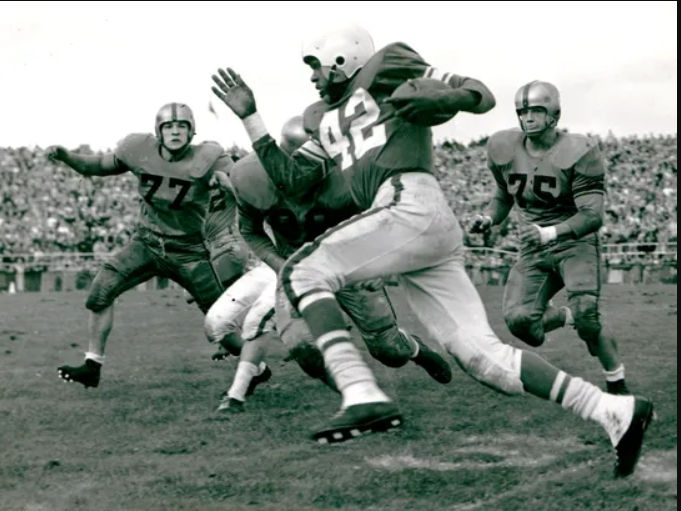
The night before the 1955 season finale the team stayed at a camp outside of town. Overnight a snowstorm came in preventing the team buses from driving the last two hundred yards or so to pick the team up.
Coach Rip Engle instructed the coaches and back-up players to walk first to tamp down the snow. They were followed by the starters, followed by two linemen who carried Lenny Moore to the bus. Engle wasn't taking any chances.
In an era where freshmen were ineligible and they played just 9 games a year, Moore put up amazing numbers in just 27 games. He rushed for 2,380 yards and 23 TDs while averaging 6.23 yards per carry. He was also a returner and receiver and rolled up 3,543 total yards. And he did this while also playing defense, as players in that era were still playing two-ways.
In the 1956 draft, the Baltimore Colts took Moore in the 1st round launching one of the most successful NFL careers of any PSU running back. His 12-year career, all played in Baltimore, was highlighted by his running and his ability to run routes and catch the ball. He was the 1956 Rookie of the Year, the 1964 NFL MVP, won 2 NFL titles, was a 5-time All-Pro and was selected to the Pro Bowl 7 times. He has also been named one of the Top 100 NFL players of all time, a video well worth watching here.
The momentum of the late 1950s continued into the sixties for Penn State. In the 1961 draft both Don Jonas (Philly) and Dick Hoak (Pittsburgh) were selected. Hoak played RB, QB and safety at Penn State and was the 1960 Liberty Bowl MVP. Hoak went on to a 10-year career with the Steelers including being selected to the 1967 Pro Bowl.
In 1972, Hoak was hired to be the RBs coach for the Steelers and coached 35 seasons for them. In 2017 he was chosen to be part of the inaugural class for the Steelers’ Hall of Honor.
As good as Hoak was, the guys who played in the early 1960s can never say enough about the respect and awe they had for RB Roger Kochman. The 1962 1st-team All-American was a gifted all-around player with a huge future. A traumatic leg injury sidetracked his career before he came back to play one year in the NFL.
Seven seasons later Charlie Pittman was a first-team All-American in 1969 as Penn State capped off two consecutive 11-0 seasons. He set rushing records at Penn State, ones that his teammate Lydell Mitchell broke. Pittman would go on to a multi-year NFL career before a long career as a newspaper editor.
In 1973 Penn State completed another undefeated season finishing 12-0 and featuring Heisman Trophy winner John Cappelletti. Cappelletti spent two years on defense while Lydell Mitchell and Franco Harris carried the ball in 1970 and 1971.
In 1972 he got his shot and responded with over 1,100 yards and 12 TDs. The next season he just missed the season rushing record on his way to 1,522 yards and 17 TDs. He was named 1st-team All-American, Penn State’s 3rd RB in 5 years to earn that honor. He won the Maxwell Award and after a promotional campaign that was quarterbacked by Sports Information Director John Morris, Cappelletti won the Heisman Trophy.
In what remains one of the all-time emotional Heisman trophy moments, Cappelletti dedicated the trophy to his younger brother Joey who was battling Leukemia. It was a speech that captured the nation. The emotional story resulted in a book and movie “Something for Joey” that shared the story of loyalty and love in a family of unshakable faith.
Cappelletti would later be enshrined in the College Football Hall of Fame. This came after being a 1st-round pick by the LA Rams and a 10-year NFL career in LA and San Diego.
As Penn State moved into the 1980s & 1990s, tailbacks continued to flock to PSU because of that precedent set by the 1970s backs.
Jonathan Williams was a 1984 pick by New England. In an important late-season 1981 win over Notre Dame, Williams ran for 192 yards starting in place of the injured Curt Warner. Along with Curt Warner and Williams, teammate Tony Mumford was drafted in 1984.
In 1983, freshman RB DJ Dozier arrived from Virgina. DJ became the first PSU freshman to rush for over 1,000 yards. Three years later he was a 1st-team All-American while helping Penn State to a 12-0 record and the 1986 National Championship.
In one of the iconic moments in Penn State history, Dozier broke through the Miami line for the go-ahead TD and immediately took a knee in a humble moment of thanks to God. That image remains vivid in the minds of every Penn State fan.
Dozier would be a 1st-round pick by Minnesota in the 1987 draft and played 5 years in the NFL. The last two years of his NFL career he also played professional baseball. Despite not having played since high school, he worked his way up to the NY Mets in 1992.
But before he left Penn State, he passed the torch to another 1st-team All-American and 1st-round draft pick in Philadelphia’s own Blair Thomas. Thomas was compact, fast and shifty and started to make his mark in 1985 as a freshman. In 1987 he became a full-time starter.
In what was one of the coldest games in Beaver Stadium history, in 1987 Penn State defeated #7 Notre Dame on a day so windy that passing the ball was nearly impossible. With both defenses stacking the lines, Thomas still gained 214 yards on 35 carries. He ran for 1,414 yards on his way to All-American honors before a freak practice knee injury sidelined him before the bowl game and cost him the 1988 season.
In 1989 he returned and after a week or two getting back into his groove, he became a dominant back amassing 1,341 yards. He concluded his career in the Holiday Bowl shootout win racking up 186 yards on 35 carries.
Another Penn State RB scored the game-clinching TD in that shootout, but he did it as a DB. In 1989 Gary Brown agreed to move to DB for one year before moving back to RB in 1990. With BYU driving and trailing by 4, Gary Brown blitzed off the edge, beat BYU’s Outland Trophy winning tackle and stole the ball from future Heisman Trophy winning QB Ty Detmer. He raced the length of the field for the final TD and sealed a 50-39 win.
Brown returned to RB and was drafted by Houston. Across his 9-year NFL career, he had multiple 1,000-yard seasons. He became a respected RB coach working his way from the high school ranks, to Rutgers, the Browns, the Cowboys and Wisconsin. In 2022 he lost his battle with cancer in his hometown of Williamsport, PA.
Brown and his 5 future NFL RB teammates would pass the torch to a trio of NFL tailbacks. Ki-Jana Carter, Stephen Pitts and Mike Archie arrived together in the same recruiting class. Carter broke out in 1993 for over 1,000 yards in Penn State’s first Big Ten season.
The next year, Carter was nearly unstoppable. A broken thumb at Temple couldn’t keep him off the field. He played the next two games at Michigan and at home against Ohio State with a soft cast to protect the thumb. At Michigan he racked up 165 yards on 26 carries in the 31-24 win. Against Ohio State he rushed for 137 yards and a whopping 4 TDs on just 19 carries in the 63-14 rout of the Buckeyes. Penn State became the first team to beat Ohio State and Michigan in back-to-back games, a feat repeated by the 2008 Penn State team.
He was the MVP of the Rose Bowl after a 156-yard 3 TD game which included a big TD run on Penn State’s first play from scrimmage. It is another one of the iconic moments in PSU football history.
Carter was named a 1st-team All-American and finished 2nd in the Heisman voting. He ran for 1,539 yards and 23 TDs on just 198 carries, a whopping average of 7.8 yards per carry. After the season he was the 1st overall pick of the NFL draft when Cincinnati selected him. In his first preseason game he injured his knee but managed to play 10 years in the NFL before retiring. He was selected to both the Rose Bowl and College Football Hall of Fame.
While Carter shined, Mike Archie was a talented dual-threat who would go on to a 3-year NFL career. All through the 1994 season Archie was a valuable receiver out of the backfield or motioning to the slot. Stephen Pitts would hit his career game high when he raced to 164 yards on 17 rushes in the 1995 "Snow Bowl" win over Michigan against one of the nation’s best run defenses.
Archie and Pitts joined fullbacks Milne and Witman giving Penn State four RBs picked in the 1996 draft.
After Ohioan Ki-Jana Carter’s run as the team’s leading rusher, another Ohioan took over as Curtis Enis led the team in 1995, 96 & 97. Enis started his first game at LB before injuries got him moved to RB. It did not take long for him to emerge as he ran for 132 yards on just 14 carries against Temple in his first game at RB.
Over the next three years he emerged as a punishing RB. The later the game got the faster he played as defenders simply got worn out. That was evident in the 1996 Kickoff Classic win over #7 USC in Giants Stadium. He amassed 241 yards and 3 TDs on just 27 carries in the 24-7 win.
In 1997 on a sunny fall afternoon, #2 Penn State fell behind 27-17 at home against #7 Ohio State. With the home crowd growing restless, fullback Aaron Harris broke into the open with a spinning chaotic TD run the close the gap in the 3rd quarter.
In the 4th quarter Enis got carry after carry before taking a handoff and splitting the OSU defense for the game winner. In that 31-27 win, Enis racked up 211 yards on just 23 carries. Enis was named a 1st-team All-American and was a 1st-round pick in the 1998 draft by Chicago.
At that time another batch of RBs were assembling in Happy Valley. Kenny Watson, Larry Johnson, Eric McCoo, Eddie Drummond and Omar Easy all came to Penn State as one century concluded and another began.
Omar Easy was a 4th round pick by Kansas City in 2002 starting a 4-year NFL career. He was born in Jamaica and picked up football late in life at Everett HS in Massachusetts. Omar is now Dr. Omar Easy and leads Penn State’s Brand Academy for current student-athletes.
Kenny Watson, Eric McCoo and Eddie Drummond were all undrafted free agents who proved the NFL scouts wrong. Drummond became an All-Pro returner.
Kenny Watson played both WR and RB and was a dangerous punt and kick returner at Penn State. His kick return to start the 3rd quarter sparked a big rally in the Fiesta Bowl win over Texas to conclude the 1996 season. The Harrisburg native would go on to an 8-year NFL career utilizing his multiple skill sets.
The player who emerged from the pack was Larry Johnson. In his first game he took a swing pass for a big score in the season opening 41-7 rout of #4 Arizona in the Pigskin Classic at Penn State.
In 2002 he became the first Penn State back to break 2,000 yards and did it on fewer carries than anyone in college football history. He finished with 2,087 yards and 20 TDs on 271 carries for a 7.7 yards per carry average. He did that while also grabbing 41 passes for 349 yards and adding kick returns for another 219 yards. His single season 2,635 all-purpose yards remains a Penn State record. He finished his career with over 1,400 career return yards.
Three times in 2002 he broke the single-game rushing record. He rushed for 257 yards against Northwestern to set the record. A few games later he ran for 279 against Illinois. Then at Indiana he rolled up 327 yards. He added a 279-yard game on just 19 carries in ONE HALF against Michigan State to eclipse the 2,000-yard mark.
After the season he was named a 1st-team All-American, the Walter Camp Player of the Year, won the Doak Walker Award and finished 3rd in the Heisman voting. He was then drafted in the first round by Kansas City. In his 8 years in the NFL Johnson was named All-Pro, earned Pro Bowl honors, led the NFL in rushing and in 2006 set the NFL record with 416 carries,
After Johnson left, the next two running backs to emerge were both Virginians from the DC area.
Tony Hunt led the team in rushing for three years on his way to finishing second only to Curt Warner in career yards. As a big back he was a punishing runner. In 2005 he teamed up with QB Michael Robinson in a one-two zone read run game duo that left defenders having to seriously consider who they would rather tackle.
In his last game, an Outback Bowl win over Tennessee, he rushed 31 times for 158 yards despite everyone knowing he was getting the ball. Tennessee just could not handle Hunt’s physical running, and he was named the game’s MVP.
After Hunt, Evan Royster would lead the team in rushing for 3 years enroute to passing Curt Warner as the school’s all-time leading rusher. His ability to line up and play WR made Royster a tough matchup for any defensive coordinator.
Hunt was drafted by Philly in 2007 and Royster by Washington in 2011. They both played multiple years in the NFL.
Other backs like Rodney Kinlaw, Zack Zwinak and Akeel Lynch bridged to the new generation of guys like Saquon Barkley, Miles Sanders, Nick Singleton and Kaytron Allen. The names you know in the current generation owe so much to the long history here.
In the backfield, that place that evolved from a rugby-type game to the Quarterback, fullback, tail back era, one day stands out in Penn State history.
As Penn State broke the huddle for the first play on December 26, 1980, to face Ohio State it was an all 1st-round pick backfield. QB Todd Blackledge, fullback Booker Moore and tailback Curt Warner would all become 1st-round NFL draft picks. On that very first play Warner went 60+ yards for a touchdown in a 31-19 win over the Buckeyes.
Booker Moore was a versatile fullback/tailback from Flint, Michigan. He was the 1st pick of the Buffalo Bills in the 1981 draft and played for 3 years before a health issue cut short his career.
Two years later, Warner was the 3rd overall pick in the draft going to Seattle. Warner’s college and pro career put him in the discussion of the greatest backs in school history. He left as the all-time leading rusher, a 2-time 1st-team All-American, a member of the 1982 National Championship team in a career that earned him induction into the College Football Hall of Fame.
He was a clutch receiver and kick returner with great speed and acceleration. He was a jump cut guy before anyone had even heard the term. He broke the 100-yard mark in eighteen games, and Penn State finished 18-0 in those games.
He was at his best in the biggest games. Two years in a row Penn State faced Heisman Trophy winning running backs in Bowl Games. Warner outrushed both USC’s Marcus Allen (1981) in the Fiesta Bowl and Georgia’s Herschel Walker (1982) in the Sugar Bowl. In 1981 Warner rolled up 145 yards on 26 carries and 2 TDs while Allen was held to 85 yards on 30 carries. The next year Warner had 117 yards and 2 TDs on just 18 carries and added another 23 yards receiving. Walker managed just 103 yards on 28 carries. All told, Warner had 417 yards and 5 TDs in three bowl wins.
His 8-year Pro Career was incredible. He was the AFC Player of the Year twice, including his rookie year in 1983. In the season opener in his second year, he blew out his knee and missed the whole season. But he came back with a vengeance. All told, he made three Pro Bowls and earned All-Pro Honors three times. In his 6 full seasons in Seattle, he rushed for nearly 6,700 yards and was selected to the Seahawks Ring of Honor.
In his time at Penn State, the guy handing Warner the ball most often was Quarterback Todd Blackledge. It is a fitting transition from the running backs to quarterbacks with the Warner/Blackledge connection. The two were roommates in college and formed the nucleus of the 1982 National Title team.
But more on Blackledge and the rest of the quarterbacks in the next essay…….


Honestly, I wasn’t expecting much when I opened this article, but it turned out to be exactly what I was looking for. I’ve been trying to find clear information about this topic for some time, and this explained things in a much easier way. I also checked here at Releaf why is cannabis illegal in the UK? and learned a few things I didn’t know before. Thanks for sharing — this was actually useful.
PSU's running back tradition is truly one of the greatest in college football history. The program has consistently developed elite talent through discipline, hard work, and outstanding coaching. It's impressive to see how each generation of running backs continues to build on that legacy while inspiring future athletes. Success on the field also comes from strength training and performance tracking. Tools like a one rep max bench calculator help players measure upper-body strength, monitor progress, and improve overall athletic performance. Great article highlighting a tradition that continues to shape the future of Penn State football.
Wow, it was wonderful revisiting the careers of all of these familiar players. A long article because Penn State has so many great running backs! While it is impossible to choose just one player as the greatest in the history of the program, Franco Harris had arguably the greatest NFL career. What wasn't mentioned about Franco was that he spent time in Joe Paterno's doghouse, which was probably a valuable lesson for a developing football player.
This is so awesome. It is truly wonderful to see the legacy of Penn State football and the Paerno era being once again recognized and honored. Thanks Jay.